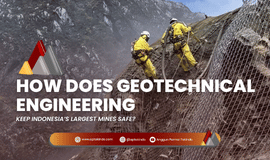
Landslides vs Mine Slope Engineering
In open-pit mining operations, one of the most persistent and significant risks is landslides. Complex geological conditions, high rainfall, and dynamic mining activities make mine slopes highly vulnerable to instability. For this reason, slope engineering becomes a critical factor that determines safety, productivity, and the long-term sustainability of mining operations.
What Is Slope Engineering?

Slope engineering is a geotechnical discipline focused on designing, analyzing, and controlling the inclination of soil and rock slopes to ensure stability throughout the life of a mine. This process includes geological characterization, stability analysis, determining safe slope geometry, and implementing deformation monitoring systems.
Mine slope engineering involves comprehensive quantitative and qualitative assessments to ensure slopes remain stable, taking into account key geotechnical parameters such as:
a. Mechanical Parameters of Rock/Soil
- UCS (Uniaxial Compressive Strength)
- GSI (Geological Strength Index)
- Young’s Modulus & Poisson’s Ratio
- Cohesion (c) & Friction Angle (φ) from direct shear or triaxial tests
- RQD & Joint Condition Ratings
These parameters determine the strength of the rock mass and serve as primary inputs for numerical analysis.
b. Discontinuity Characteristics
Discontinuity analysis (joint sets, bedding planes, fault zones) is essential for predicting potential failure mechanisms:
- Plane failure when a discontinuity dips out of the slope
- Wedge failure when two joint sets intersect
- Toppling when joint orientation promotes forward rotation due to slope geometry
Stability Analysis: From Limit Equilibrium to Numerical Modelling

Once geotechnical characteristics are identified, engineers proceed with slope stability analysis. The most commonly used approach is the Limit Equilibrium Method (LEM), such as Bishop, Janbu, and Morgenstern–Price. This method calculates the Factor of Safety (FoS) to determine whether resisting forces exceed driving forces.
However, in areas with more complex geology, slope engineering relies on numerical modelling (FEM/DEM) using software such as RS2 or FLAC3D. These models provide more detailed insights into stress distribution, plastic zones, and deformation patterns that may not be visible on the surface.
The analytical results guide adjustments to bench height, catch berm width, and overall slope angle, ensuring the slope design remains safe while still achieving production targets efficiently.
Slope Reinforcement: Locking, Restraining, and Controlling

When the analysis indicates potential shallow failures, engineers install reinforcement systems such as:
- Rock bolts and cable bolts to anchor rock blocks
- Shotcrete or fiber-reinforced shotcrete for surface confinement
- Mesh or geogrid to prevent raveling
- Rockfall barriers capable of absorbing impacts greater than 2000 kJ
These reinforcements are not “patches,” but integral elements of a slope design defined during the analytical phase. After design and reinforcement are implemented, operations do not stop there. Modern mines rely on real-time monitoring such as:
- Slope Stability Radar (SSR/MSR)
- LiDAR and drone photogrammetry
- Prism monitoring
- Sensors such as extensometers and piezometers
These tools detect deformations at the millimeter scale. Even small changes often signal that an area is trending toward a critical condition. Without monitoring, a slope that appears stable can fail without warning.
Conclusion
Slope engineering is not merely a technical procedure, it is the backbone of safe and sustainable mining. Through proper slope optimization, companies not only reduce the risk of landslides but also enhance productivity and protect the safety of their workforce.
In a high-risk industry like mining, slope engineering is an investment not an option.
References
- Share